
Whether you're a small business shipping frozen steaks, a lab sending medical samples, or a parent overnighting breast milk, dry ice is your best friend. It's incredibly effective, keeping packages significantly colder than standard gel packs.
However, dry ice isn't just "really cold ice." It is classified as a hazardous material by the FAA and DOT because of how it behaves as it warms up. If you don't package it correctly, you aren't just risking spoiled goods—you're creating a literal bomb.
What is Dry Ice?
Dry ice is solid carbon dioxide (CO2). Unlike regular ice made from water, dry ice doesn't melt into a liquid. Instead, it undergoes sublimation—it transforms directly from a solid state into a gas at -109.3°F (-78.5°C).
This is why it's so popular for shipping: there is no messy puddles or water damage to worry about. But that sublimating gas is exactly what makes it hazardous during transit.
The Golden Rule: Never Seal It Tight
As dry ice turns into carbon dioxide gas, it expands. If that gas is trapped inside a perfectly sealed, airtight container, the pressure will continuously build until the container violently bursts. In an airplane cargo hold or a delivery truck, this is a catastrophic safety hazard.
⚠️ Explosion Hazard
You must NEVER completely seal the inner cooling container or the outer shipping box with tape. The packaging must allow for the release of carbon dioxide gas.
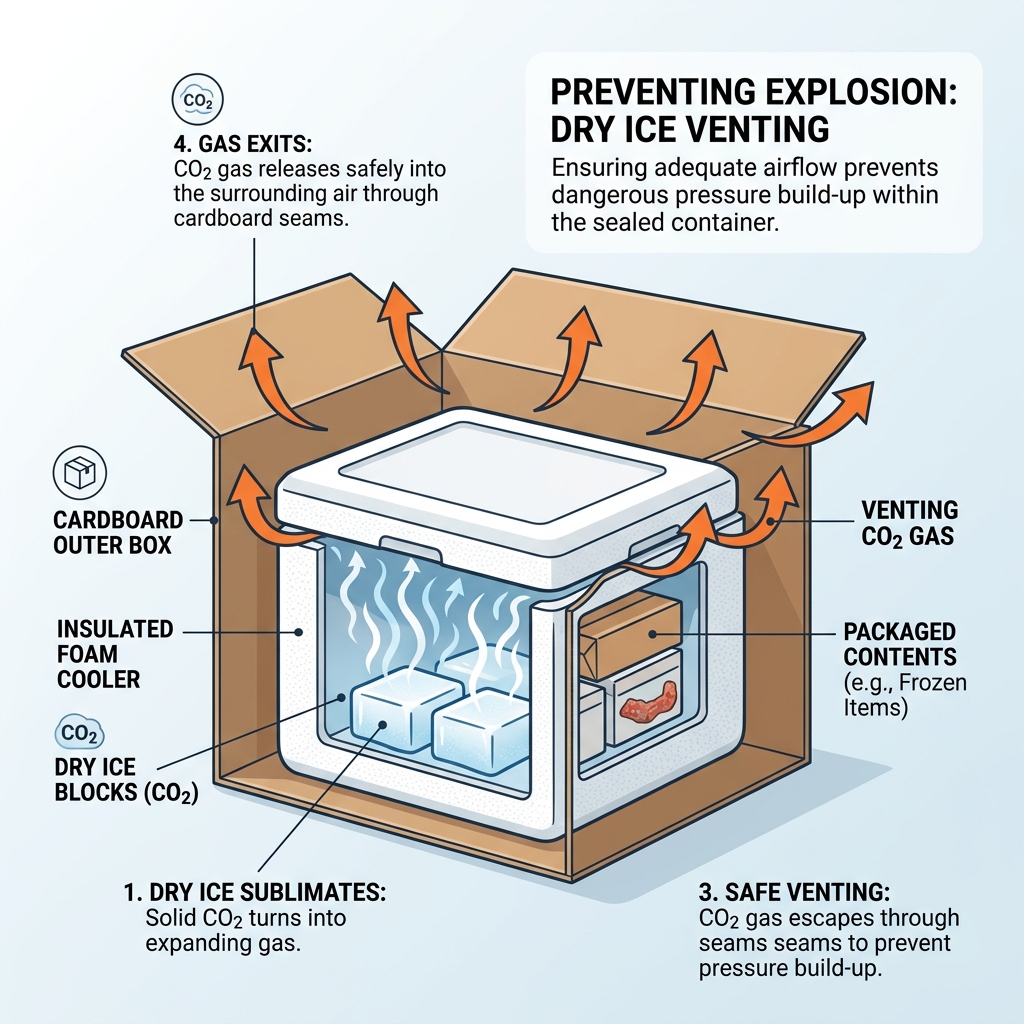
Proper packaging allows CO2 gas to safely vent out of the box seams.
How to pack it safely:
- Use a high-quality expanded polystyrene (EPS) foam cooler inside a corrugated cardboard box.
- Place your items inside the cooler, and add the dry ice on top (cold air sinks).
- Place the lid on the foam cooler, but do not tape the cooler lid shut. If you must tape it to keep it from bouncing off, only tape two opposite sides so air can escape the others.
- Seal the outer cardboard box using the H-tape method, but do not wrap the entire box in tape or plastic wrap. Standard seams are perfectly fine for venting.
Calculating Sublimation Rates (How Much Do I Need?)
You can't just throw in a block of dry ice and hope it lasts. Because it constantly turns to gas, you are racing against the clock.
As a general rule of thumb, dry ice sublimates at a rate of 5 to 10 pounds every 24 hours when packed in a standard foam cooler. This rate depends on the thickness of your foam cooler and the ambient temperature during shipping.
💡 Pro Tip
If you are shipping a package that will take 48 hours to arrive, you should include a minimum of 10-15 pounds of dry ice to ensure your product stays frozen until delivery.
Always buy dry ice as close to your shipping time as possible. If you buy it the night before, a significant chunk will vanish before you even hand it to the carrier.
The UN 1845 Hazard Label
Because dry ice displaces oxygen as it turns into gas, carriers need to know exactly how much of it is in their truck or airplane so they don't suffocate. By law, any package containing dry ice must be clearly marked.
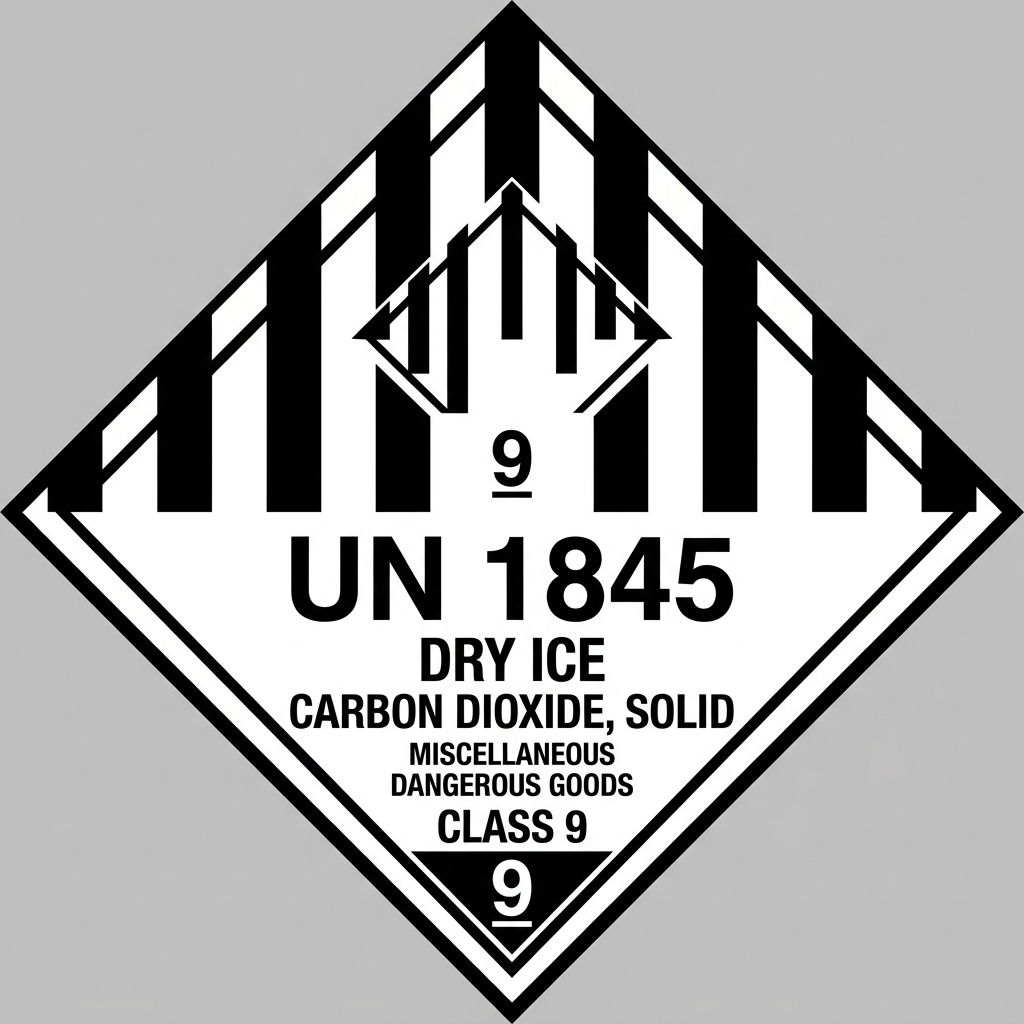
Class 9 Miscellaneous Dangerous Goods
You must affix a Class 9 diamond label to the outside of your box. Additionally, the side of the box must clearly display:
- The words "Dry Ice" or "Carbon Dioxide, Solid"
- The UN number: UN 1845
- The net weight of the dry ice in kilograms (e.g., 4 kg)
- The name and address of the shipper and recipient.
Carrier-Specific Rules
UPS and FedEx
Both UPS and FedEx gladly accept dry ice shipments. For shipments containing 5.5 lbs (2.5 kg) or less, you usually don't need a formal Dangerous Goods contract, but you still must use the proper UN 1845 markings and declare the weight during the label creation process.
USPS (United States Postal Service)
USPS allows domestic dry ice shipments, but with strict limitations. You can only ship up to 5 lbs of dry ice via air transportation. You must present the package at a retail counter—you cannot drop it in a collection box. We highly recommend using UPS or FedEx for frozen shipments due to their guaranteed delivery times.