
There is nothing worse than sending a family heirloom, a piece of artwork, or a delicate glass vase to a loved one, only to hear that it arrived in shattered pieces. Shipping fragile items requires far more than just a layer of bubble wrap. It requires engineering your package to survive a 4-foot drop onto concrete.
The "Fragile" Sticker Myth
Let's debunk the biggest myth in shipping right now: Writing "Fragile" on the outside of your box does absolutely nothing.
Modern shipping networks (whether it is USPS, UPS, or FedEx) are highly automated. Your package will travel down miles of high-speed conveyor belts, drop down mechanical chutes, and be stacked under 50-pound boxes of dog food in the back of a delivery truck. A machine cannot read a "Fragile" sticker, and the workers loading the trucks are moving too fast to treat individual boxes with white gloves.
The only way to guarantee your item survives is to pack it so securely that it doesn't need to be handled gently.
Mastering Void Fill: The 2-Inch Rule
"Void fill" is the industry term for the material you use to fill the empty space inside a box. If your item can shift, slide, or rattle when you shake the box, it is going to break.
- Bubble Wrap: The undisputed champion for wrapping the item itself. Always wrap the item with the bubbles facing inward (touching the item) to maximize shock absorption.
- Packing Peanuts: Excellent for filling void space and suspending the item in the center of the box. However, they settle during transit. You must slightly overfill the box so the peanuts compress tightly when you tape the flaps shut.
- Air Pillows: Good for lightweight items, but terrible for heavy fragile items (like a cast iron pan) because the weight of the item will simply pop the pillows upon impact.
- Crushed Kraft Paper: A great eco-friendly alternative to peanuts, provided you crumple it tightly and use enough of it.
💡 The 2-Inch Rule
You must maintain a minimum of 2 inches of dense void fill between the fragile item and all six walls of the outer box. If the item touches the inner cardboard wall, any impact to the outside of the box will transfer directly into the item, shattering it instantly.
The Ultimate Protection: The Box-in-a-Box Method
For highly valuable or extremely delicate items, standard bubble wrap isn't enough. You need to use the "Box-in-a-Box" (or "Overboxing") technique. This is exactly what it sounds like.
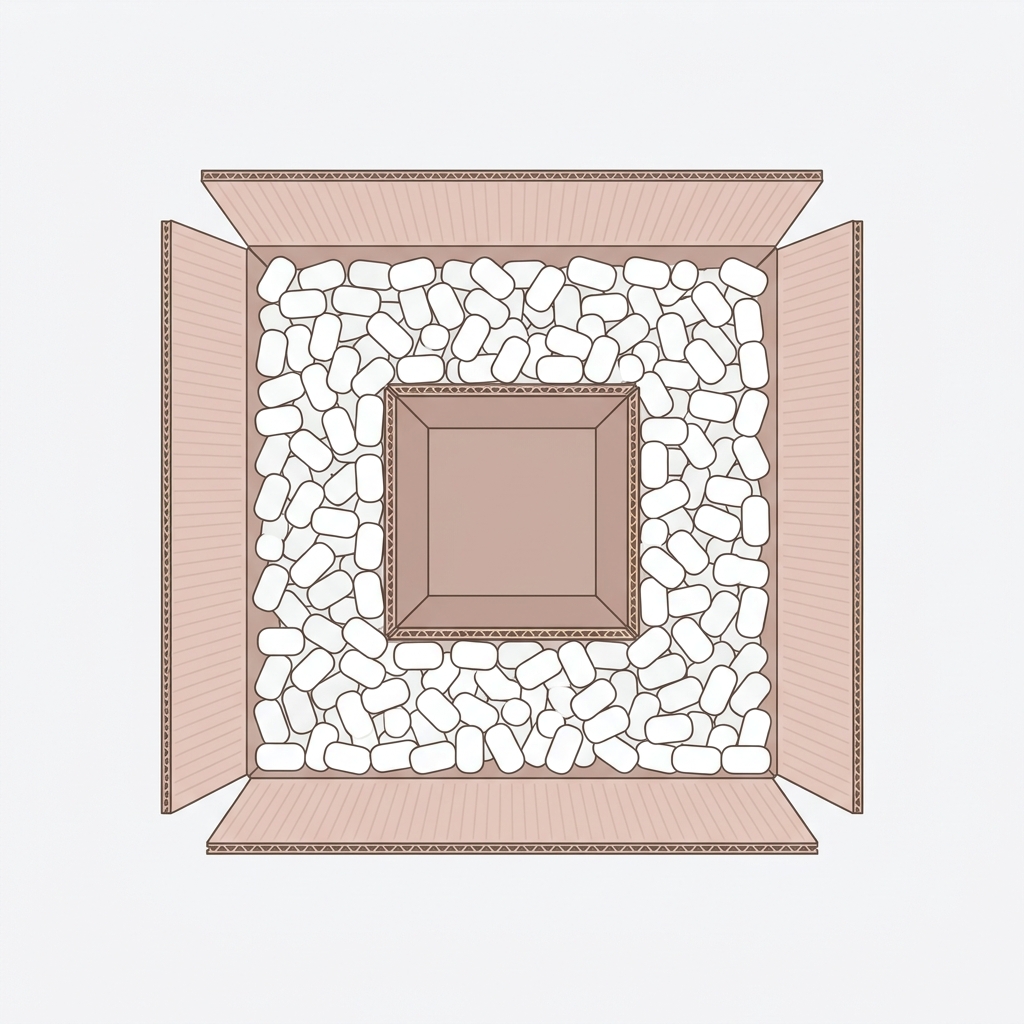
How to do it:
- Wrap the fragile item tightly in bubble wrap and place it snugly into a small cardboard box.
- Seal the small box.
- Get a second, larger box. Put 2 to 3 inches of packing peanuts in the bottom.
- Place the small box directly in the center of the large box.
- Fill all the remaining empty space around the sides and top with more peanuts, ensuring the small box is completely suspended in the center.
This creates a physical crumple zone. If the outer box is crushed by a heavier package, the inner box remains completely untouched.
The H-Tape Sealing Method
All your careful void fill is useless if the box bursts open during transit. A single strip of tape across the top flaps is rarely enough to secure a heavy package.

Professional shippers use the H-Tape Method. This involves applying heavy-duty 2-inch wide packing tape (never use masking tape or duct tape) in three distinct strips:
- One strip down the main center seam where the flaps meet.
- One strip across the left edge seam.
- One strip across the right edge seam.
This creates an "H" shape that prevents the corners of the flaps from snagging on conveyor belts and ripping open.
Do I Need Shipping Insurance?
⚠️ Insurance Doesn't Cover Poor Packaging
If you purchase $500 of insurance on a fragile vase, but you packed it by tossing it into a box with a single piece of newspaper, the carrier will deny your insurance claim. Carriers only pay out if they deem the item was packaged according to their strict ISTA (International Safe Transit Association) guidelines.
If you follow the 2-inch rule and the Box-in-a-Box method, your package is highly likely to meet carrier standards. In that case, purchasing additional declared value coverage is a smart move for items worth more than $100.
Before you ship, always make sure your item isn't restricted by using the Can I Ship It Tool on our homepage!